



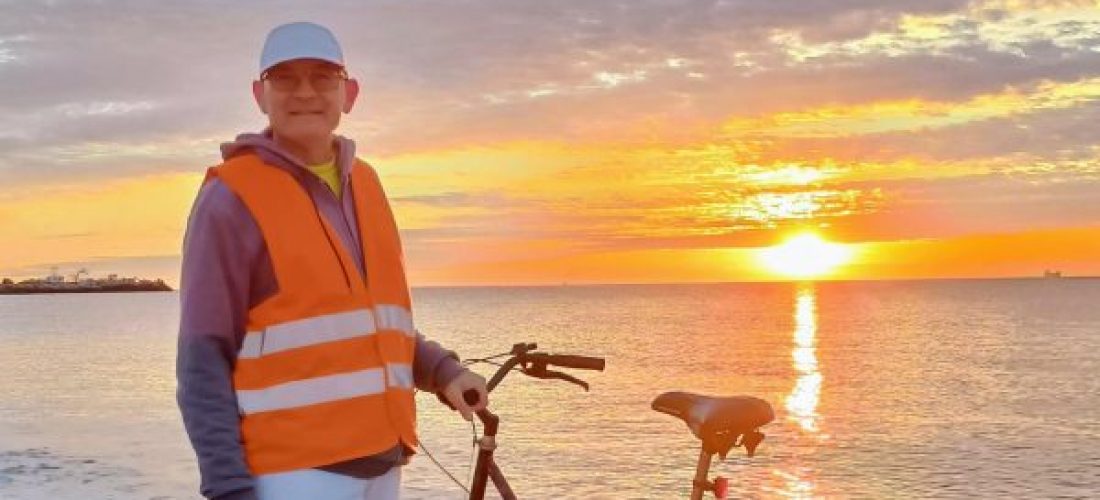
Instead of a Bio: I am Teodosi Byalkov and I am a father of two sons, with a mortgage, I work in two places. I like to ride a bike very often. I do it almost every morning. I leave the house, see the sea and come home again to work, since I am a “home office”.
When and how did you decide to switch from driving to cycling as your main way of commuting to work?
To be honest, I only use my car when I really need to. In Varna, where I live and work, the distances aren’t that big — nothing like in Sofia. For me, choosing to drive only makes sense if the commute is really long. Mine never has been.
From that perspective, even ten years ago, this question didn’t really exist for me — I’ve always preferred to walk or cycle to work. There was a time when I lived in a more distant neighborhood, and back then the kids were small. Without a car, it was hard to manage all the daily logistics, so I used it quite a lot during those years.
Now, though, the kids have grown up and can get around on their own. For a while, my younger son and I even cycled to school together — it was close enough.
Overall, the choice between car and bike has never been a big dilemma for me. Still, it does come up occasionally. For instance, before a business meeting, I sometimes ask myself, “Car or bike?” If it’s not too hot, too far, or raining, the bike always wins. The car stays as a backup — only for those days when the circumstances really work against cycling.
Bike2Work Announces the Top 5 Cycling Leaders
What’s the biggest challenge in cycling to work, and how do you overcome it?
The biggest challenge, most often, is that the infrastructure just isn’t built properly. To be fair, there has been some improvement in recent years. A while back, Varna launched the Integrated Urban Transport project, and that’s when the first bike lanes appeared.
They did appear — but in many places, they were built in the wrong way and in the wrong places. In my opinion, the goal back then was to make construction easier for the contractors, not to solve a real transportation problem. The idea should have been to help people feel safe and confident, and to encourage more cyclists on the road.
That said, I have to admit — even though the bike lanes weren’t made perfectly, the number of cyclists has grown since then. However, many of those lanes constantly create conflict between cyclists and pedestrians. In a lot of areas, the lanes were placed on wide sidewalks, which directly takes space away from pedestrians — from parents with strollers, or anyone simply walking.
Sometimes the bike lanes are new and smooth, while the sidewalks next to them are old and uneven. Naturally, a mother with a stroller will choose to walk on the flat bike lane instead of the broken pavement. It turns into a shared space where everyone moves together — and not always safely.
So yes, poor infrastructure is the biggest challenge. I often talk to friends and ask them, “Why don’t you bike to work? It’s not far.” The answer is almost always the same: “I’m scared.” And I understand that, because I’ve been in tricky situations myself.
For example, when Varna built its bike lanes, they made them two-way on one side of the boulevard, instead of one-way lanes on both sides. That creates real safety issues. When a driver exits a side street, they have to cross the bike lane. They look left — where the cars are coming from — but forget to look right, where cyclists might be approaching.
I experienced this firsthand one morning. I saw a driver looking left, assumed he wouldn’t move, and started to pass in front of his car. Just as I was crossing, he pulled out. I ended up on his hood. Thankfully, we both walked away shaken but unharmed. We apologized to each other and went our separate ways.
That incident really shows how important proper infrastructure is. When it’s poorly designed, it doesn’t just fail to help — it actually creates dangerous situations.
What would you change or improve about your route to the office?
Well, this ties in with what we discussed earlier. The most important thing is for the infrastructure and bike lanes to be built in a way that actually serves their purpose.
There’s also something else I’d like to see changed. This question reminded me of an idea I’ve had for a while. I think the law should allow cyclists to legally ride against traffic in residential areas — the smaller streets where there are no big boulevards.
Right now, if you strictly follow the rules, you have to ride in the same direction as cars. I try to do that, but it’s often inconvenient and limiting.
In many European countries, there are already specific signs that allow cyclists to ride in the opposite direction on narrow local streets. It gives you more flexibility when choosing your route, allows for shortcuts, and makes commuting more efficient.
That way, you don’t have to think, “Well, I broke the rules a little again.” If I could change one thing, it would be exactly that. It’s a simple, quick fix that could make many cyclists feel more confident on the road.
Of course, these neighborhoods should also be designated “calm zones” where cars are limited to 30 or even 20 kilometers per hour. Realistically, that’s the change I’d most like to see happen.
Do you manage to inspire your colleagues to cycle or take part in #Bike2Work through your own example?
I hope so! Honestly, I’ve noticed that more and more people are cycling. Just seeing other cyclists on the road is motivating in itself — it shows that it’s possible, and that it’s not something to be afraid of trying.
I haven’t tried to convince people deliberately, although I did tell a friend once, “Come on, give it a try — get on a bike once in a while.” Mostly, I lead by example simply by cycling every day.
I often share photos of my bike or my daily routes on social media. I like to think that, in some small way, that also inspires others to join in.
What do you enjoy most about cycling? How does it feel to ride your bike early in the morning?
Cycling gives me a wonderful sense of freedom. It lets you move quickly from point A to point B without worrying about traffic jams. In an urban environment, it’s often the fastest way to get around.
When you ride regularly, you start discovering your own little shortcuts — stairways, paths, quiet streets. That only enhances the feeling of independence and ease.
Lately, I’ve been riding a city bike that actually belongs to my wife, but I use it more often. I equipped it with panniers, and it’s become my reliable everyday companion — almost a full replacement for the car. If I don’t need to carry anything bulky, I even use it for grocery runs to Lidl and back.
The bike does an amazing job. And the more people choose to move around by bicycle, the quieter, cleaner, and more pleasant our cities will become. There are so many benefits — people just need to realize them and take that first step.
Do you like listening to music while cycling to work? If so, what kind?
When I’m on my bike, I’m almost always listening to something — but not music. Usually, it’s Storytel or a podcast. Music only occasionally. Over the past two or three years, I’ve realized how great it is to combine my commute with something meaningful.
I like listening to content that interests me — an audiobook I never got around to reading when I was younger, or an engaging podcast episode. It makes the ride both productive and enjoyable.
But there’s one important rule I always follow: if you’re cycling and listening, always keep one ear open. I mean that literally — one ear should stay free so you can hear what’s happening around you, especially if you’re on the streets.
Even when I’m riding through the Sea Garden, I still use only one earbud. You need to be aware of what’s happening behind and around you to react quickly and safely.
Listening to music or podcasts while cycling can be a great combination — as long as you do it responsibly.

